Neocaridina Water Parameters: GH, KH, TDS & Hardness Ranges
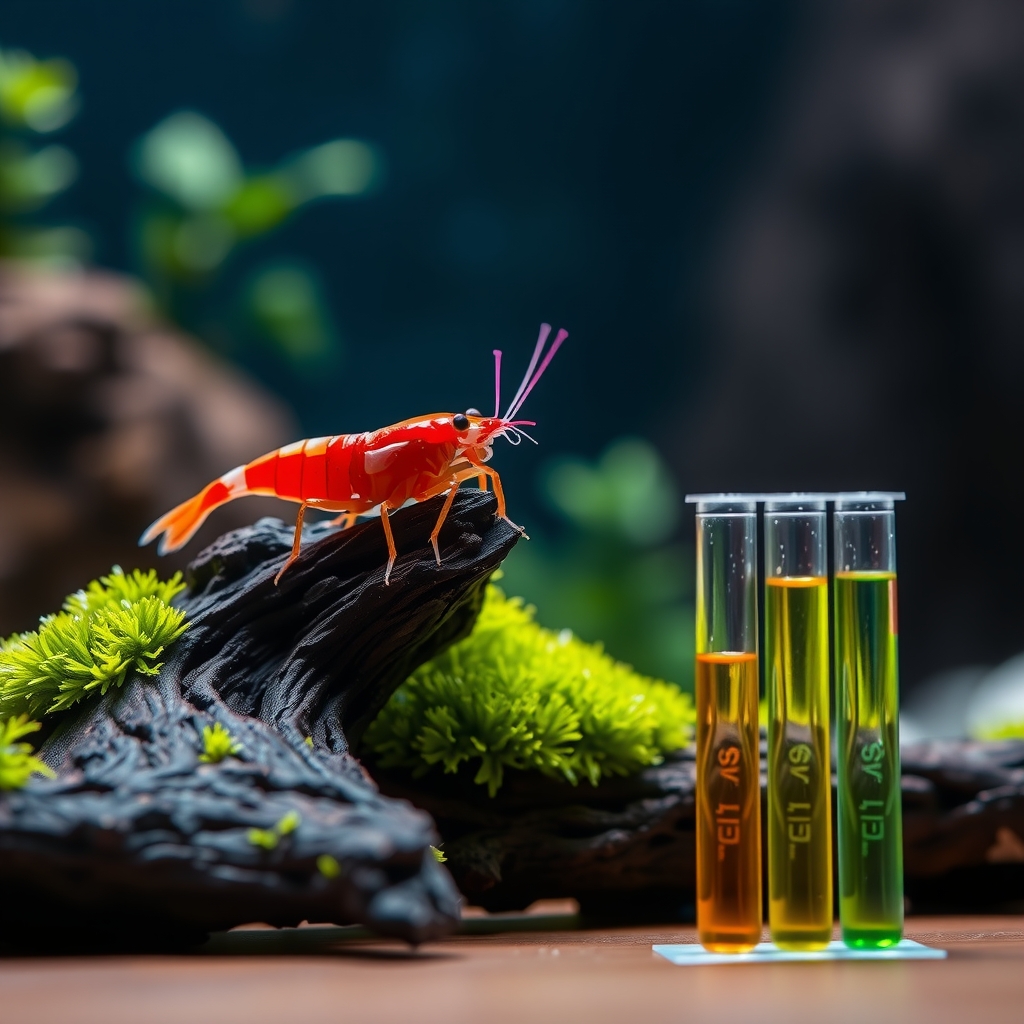
Cherry shrimp are forgiving about a lot of things, but they are unforgiving about sudden change. If you get the ranges below roughly right and change them slowly, Neocaridina will breed for you almost regardless of what else you do.
Here are the numbers worth knowing:
| Parameter | Safe range | Ideal |
|---|---|---|
| Temperature | 65–80°F (18–27°C) | 72–76°F (22–24°C) |
| pH | 6.5–8.0 | 7.0–7.6 |
| GH (general hardness) | 4–8 dGH | 6–8 dGH |
| KH (carbonate hardness) | 2–8 dKH | 3–5 dKH |
| TDS | 150–300 ppm | 180–250 ppm |
| Ammonia / Nitrite | 0 ppm | 0 ppm |
| Nitrate | under 20 ppm | under 10 ppm |
GH is the one people get wrong
General hardness measures calcium and magnesium, and shrimp need both to build a new exoskeleton every time they molt. This is the single most common cause of molting failure.
If your GH sits below about 4 dGH, shrimp struggle to complete a molt and get stuck partway — the problem hobbyists call the white ring of death. Raising GH is straightforward: use a remineraliser made for shrimp rather than tap water conditioners, and add it to your top-up water rather than dosing the tank directly.
Going too high is also possible but much rarer. Above roughly 10 dGH the shell can harden faster than the shrimp can shed it.
Temperature: stable beats optimal
Neocaridina survive a wide temperature band, so the exact number matters less than how much it moves. A tank held steadily at 78°F is healthier than one swinging between 72°F and 78°F daily.
Warmer water speeds up metabolism and breeding but holds less oxygen and shortens lifespan. Around 72–76°F is a reasonable compromise. Most rooms do not need a heater at all.
Ammonia and nitrite are non-negotiable
Everything else on this list is a range. These two are absolutes: both must read zero. Shrimp are considerably more sensitive to ammonia than fish, and by the time you can see distress the exposure has usually already done damage.
If either reads above zero, your tank is not fully cycled or your filter has been disrupted. Do daily partial water changes with temperature-matched, remineralised water until both return to zero.
TDS is a shortcut, not a parameter
Total dissolved solids measures everything dissolved in the water at once. It is useful as a quick daily check — a sudden TDS change tells you something moved — but it cannot tell you what moved. A tank at 250 ppm could have healthy mineral content or a nitrate problem. Use TDS to spot change, then test GH and nitrate to find out what changed.
Changing parameters safely
This matters more than any individual number. Shrimp handle a wrong-but-stable parameter far better than a correct-but-sudden one.
- Never change more than about 10% of a parameter per day.
- Drip acclimate new shrimp over 2–3 hours, not 20 minutes.
- Match temperature and remineralise water before it goes in the tank.
- Change 10–15% weekly rather than 50% monthly.
If a reading is off, resist the urge to correct it immediately. A slow correction over a week is almost always safer than a fast one today.
Common questions
What GH do cherry shrimp need?
Between 4 and 8 dGH, with 6–8 dGH ideal. Below 4 dGH shrimp often fail to complete molts because they cannot build a new exoskeleton.
Do cherry shrimp need a heater?
Usually not. Neocaridina do well at normal room temperature, roughly 68–76°F. A heater is only worth adding if your room drops below about 65°F or swings widely between day and night.
What TDS is best for Neocaridina?
Around 180–250 ppm. More important than the exact figure is that it stays steady — a sudden TDS shift is a signal that something in the tank has changed.
Can I use tap water for a shrimp tank?
Sometimes, if your tap water already sits in the right GH and KH range and is dechlorinated. Many keepers instead use RO water remineralised with a shrimp-specific product, because it gives a repeatable result regardless of what the utility does.